Why Rest Doesn't Feel Restful (And What Your Nervous System Wants Instead)

You slept eight hours. You finally had a quiet evening. You even took a break from your never-ending to-do list... yet somehow, you're still exhausted.
If you've ever wondered, "Why am I still so tired even when I rest?" you're not alone.
Many women believe they need more sleep, another vacation, or simply more discipline to feel better. While those things can certainly help, they often don't address the deeper issue.
Sometimes the problem isn't that you're not resting.
It's that your nervous system doesn't know how to receive rest.
When your body has spent years operating in survival mode, slowing down can actually feel uncomfortable—even unsafe. Learning to truly rest isn't about doing less; it's about helping your body believe it's finally safe to let go.
Rest Isn't the Same as Restoration
We often use the words rest and restoration interchangeably, but they aren't the same thing.
You can:
Sleep eight hours.
Spend an entire Saturday on the couch.
Watch your favorite TV show.
Take a vacation.
…and still feel completely drained.
Why?
Because your brain may still be working overtime.
If your nervous system is constantly scanning for problems, anticipating everyone else's needs, replaying conversations, or planning tomorrow's responsibilities, your body never fully shifts into a restorative state.
This is why so many women say:
"I don't know why I'm so tired."
If that sounds familiar, I encourage you to also read Why Am I So Tired All the Time?, where we explore how chronic stress and nervous system overload can leave you feeling exhausted even when your body appears to be resting.

Your Nervous System May Still Be Living in Survival Mode
Our nervous system is beautifully designed to protect us.
When we experience stress, conflict, unpredictability, or emotional overwhelm, our bodies activate their built-in survival responses.
In fact, stress itself isn't the enemy—it's your body's natural response to challenge.
The problem arises when stress becomes chronic, leaving your body unable to fully return to a state of balance.
That's helpful during genuine danger.
The problem is that many of us never learned how to come back out of that state.
Instead, we learned to become:
the responsible one
the peacemaker
the perfectionist
the caretaker
the one who always keeps everything together
Over time, those patterns become our norm.
Your body begins to believe that staying alert is what keeps you safe.
If you grew up feeling like your emotional needs weren't consistently acknowledged or supported, this may sound familiar. In 10 Signs of Childhood Emotional Neglect, I talk about how early experiences can quietly shape how we move through adulthood—including how difficult it can be to truly relax.
Likewise, in Why Am I a People Pleaser? In The Childhood Connection, we explore how consistently putting everyone else's needs ahead of your own can keep your nervous system in a near-constant state of vigilance.
None of this means you're broken.
It simply means your body adapted the best way it knew how.
Signs You're Resting…But Not Restoring
You might recognize yourself in some of these experiences:
You sleep through the night but wake up exhausted.
You finally sit down, but your mind won't stop racing.
You feel guilty for relaxing because you "should" be doing something productive.
You return from vacation feeling like you need another vacation.
You constantly reach for your phone because silence feels uncomfortable.
You struggle to enjoy downtime without thinking about everything that still needs to get done.
You feel physically tired but mentally wired.
If several of these resonate with you, your nervous system may still be operating from a place of protection instead of restoration.
For a deeper look at the physical and emotional signs of nervous system overload, be sure to read 7 Signs Your Nervous System Is Running on Empty.
Why Rest Can Feel Uncomfortable
This is one of the most surprising parts of healing.
Many people assume that once they finally have time to slow down, they'll feel relaxed immediately.
But often, the opposite happens.
You finally stop...
…and suddenly the anxiety gets louder.
One framework that helps explain this experience is Polyvagal Theory, developed by Dr. Stephen Porges.
The theory suggests that your nervous system is constantly scanning for cues of safety or danger—a process called neuroception.
When your body perceives danger, even subconsciously, it can remain in protective states like fight, flight, or shutdown, making genuine relaxation
difficult. You can learn more about the theory on Dr.Stephen Porges' website.
The racing thoughts become more noticeable.
The emotions you've been pushing aside begin to surface.
That isn't because you're doing something wrong.
It's because your nervous system has finally found enough quiet to let you notice what has been there all along.
For many women, busyness became a coping strategy.
If we're always doing, fixing, helping, organizing, achieving, or taking care of someone else, we don't have to sit with our own emotions.
Rest removes the distraction.
Healing gently invites us to be present rather than productive.

What Your Nervous System Actually Wants
Your nervous system isn't asking you to become a different person.
It's asking you to feel safe.
Safety often looks much smaller—and much gentler—than we imagine.
Instead of waiting for an entire weekend off or the perfect vacation, consider creating tiny moments throughout your day that tell your body:
"You're safe right now."
That might look like:
Taking five slow breaths before checking your phone.
Sitting outside for a few quiet minutes.
Drinking your morning coffee without multitasking.
Walking in nature.
Stretching your body gently.
Placing one hand on your heart and one on your belly.
Saying "no" without immediately explaining yourself.
Letting yourself rest before you've finished every task.
These small moments may seem insignificant.
But to a nervous system that's been living in survival mode for years, they're powerful reminders that life doesn't always have to feel urgent.
If you're looking for simple ways to begin practicing this every day, my Overstimulated Woman Reset Kit offers gentle exercises designed to help your body transition out of overwhelm and into greater calm.
Healing Happens One Safe Moment at a Time
One of the biggest misconceptions about healing is that you'll suddenly wake up one day feeling completely different.
Most healing doesn't happen that way.
Instead, healing is often wonderfully ordinary.
It's choosing to pause before reacting.
It's noticing your shoulders are tense and allowing them to soften.
It's recognizing when you're slipping back into people pleasing.
It's giving yourself permission to rest without earning it.
It's learning to trust yourself again.
Each small choice teaches your nervous system something new:
"Maybe I don't have to stay on guard all the time."
That's how lasting healing happens.
Not through perfection.
Through repetition.
If you'd like to explore the emotional side of this journey even more deeply, I invite you to read Healing the Heart, where we discuss reconnecting with yourself through compassion rather than criticism.

Final Thoughts
If rest hasn't been feeling restful lately, please know this:
There is nothing wrong with you.
Your body isn't failing you.
It's protecting you the best way it knows how.
And the beautiful thing about the nervous system is that it can learn.
With patience.
With compassion.
With consistency.
Little by little, your body can begin to understand that it no longer has to stay in survival mode.
One gentle moment at a time, you can create a new relationship with rest—one that feels restorative instead of simply another item on your to-do list.
Because true healing isn't about becoming someone new.
It's about helping your body remember what safety has felt like all along.
Frequently Asked Questions
Why am I still tired after getting enough sleep?
If you're getting enough sleep but still waking up exhausted, your body may need more than just rest—it may need restoration. When your nervous system has been living in survival mode for a long time, it can stay on high alert even while you sleep. Chronic stress, emotional overwhelm, and constant mental load can prevent your body from fully relaxing and recovering, leaving you feeling tired despite a full night's sleep.
What is the difference between rest and nervous system restoration?
Rest usually means taking a break from activity, such as sleeping, sitting down, or watching television. Restoration goes a step further. It happens when your nervous system feels safe enough to shift out of survival mode and into a state where your body can truly recover. While sleep is an important part of restoration, emotional safety, relaxation, and nervous system regulation also play a vital role.
Can chronic stress affect how rested I feel?
Yes. When your body experiences ongoing stress, it can remain in a heightened state of alert known as the fight-or-flight or freeze response. Even after the stressful event has passed, your nervous system may continue to act as if it needs to stay on guard. This can make it difficult to feel refreshed, focused, or energized, even after resting.
Why do I feel guilty when I try to rest?
Many women were raised to believe that their value came from being productive, helpful, or taking care of everyone else. If you learned to put your own needs last, slowing down may feel uncomfortable or even undeserved. Feeling guilty about resting is often a learned response—not a sign that you're lazy. Part of healing is learning that rest is a basic human need, not something you have to earn.
What are some signs my nervous system is stuck in survival mode?
Common signs include feeling exhausted but unable to relax, racing thoughts, trouble falling asleep or staying asleep, feeling overwhelmed by small tasks, becoming easily irritated, constantly worrying, and always feeling like you need to be "doing" something. If these experiences sound familiar, your nervous system may be asking for gentle support rather than pushing yourself even harder.
How can I begin regulating my nervous system?
Healing doesn't have to be complicated. Start with small, consistent practices that help your body feel safe. Slow, intentional breathing, spending a few minutes in nature, gentle stretching, mindful movement, reducing overstimulation, and creating moments of quiet throughout your day can all support nervous system regulation. Small steps practiced consistently often have a greater impact than trying to change everything at once.
Will my nervous system ever heal?
Yes. The nervous system is designed to adapt and learn throughout your life. While healing doesn't happen overnight, your body can develop new patterns of safety and regulation. With patience, self-compassion, and consistent practice, many people notice they begin to feel calmer, more resilient, and more rested over time. Healing isn't about becoming a different person—it's about helping your body remember that it no longer has to live in survival mode.
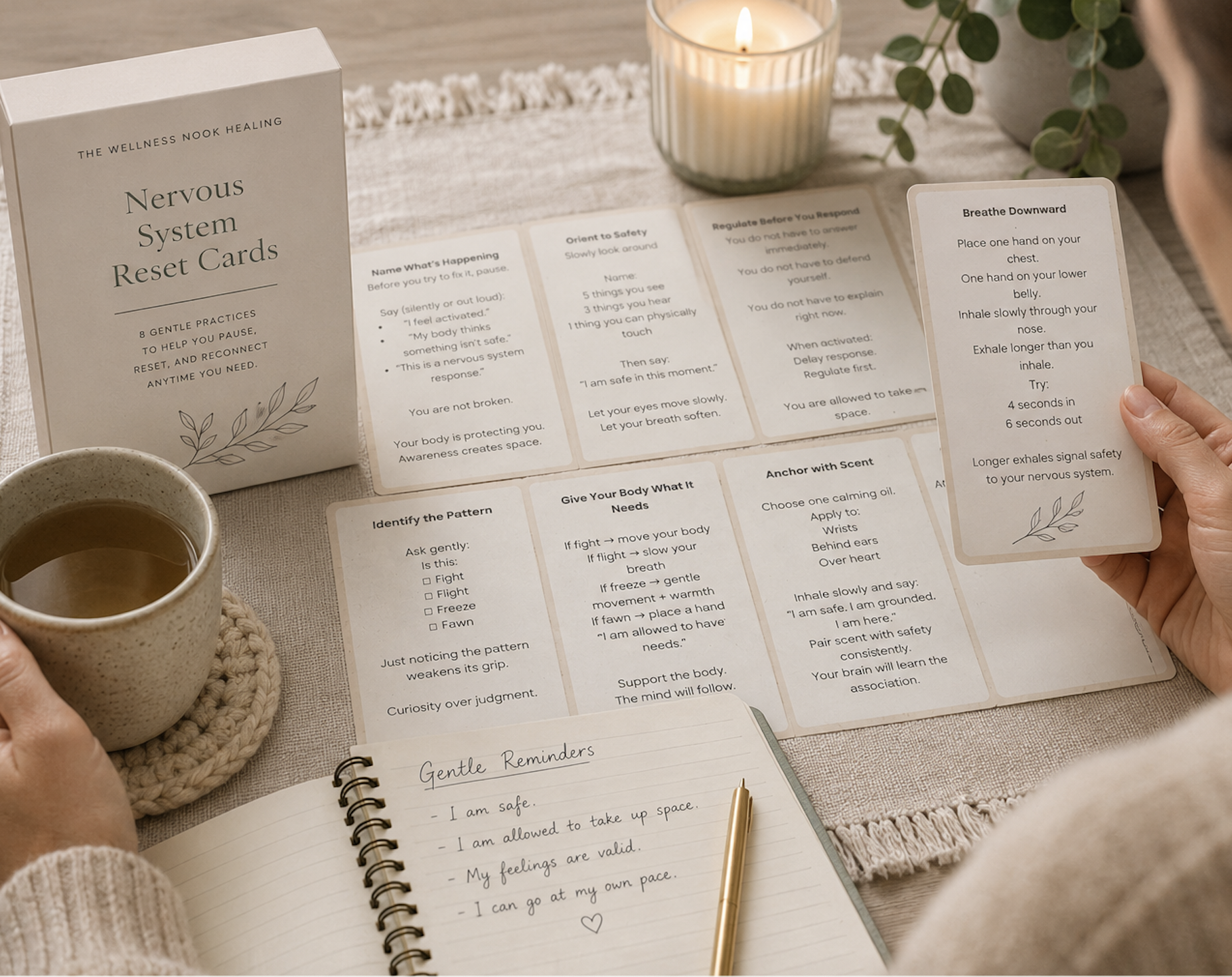
Ready to Experience More Restful Moments?
If your nervous system has been craving a little more peace, I'd love to help.
Download my FREE Nervous System Reset Cards—a collection of simple, two-minute practices designed to calm overwhelm, regulate your nervous system, and help you reconnect with yourself throughout the day.
Whether you have two minutes or twenty, these gentle exercises are an easy place to begin your healing journey.
